Black holes as density centers
PART 2 of 4
Scientific descriptions of the big bang consistently assume that the stuff blown out of the singularity during those first zillionths of a second consisted exclusively of the most primal things we know of: free-floating quarks and gluons that had not yet been bound into protons and neutrons. But that description merely reflects science’s proclivity to reductionism—unthinking default to a quite wrong assumption that all things can be understood by mentally reducing them to their smallest parts, as if the very real phenomenon of “emergence” (about which more later) did not exist. But whether quarks and gluons really were the “only” first constituents is unknowable, it just happens to be science’s habitual assumption.
An equally rational assumption goes like this. The big bang was a spectacularly messy chaos, and a lot of unique things happened while that primordial energy was blowing itself to—as they say—smithereens. There is no reason to exclude the possibility that the explosion ejected, in addition to quarks and gluons, quite a few un-disintegrated chunks of the singularity itself. So on equally valid grounds, let’s assume it.
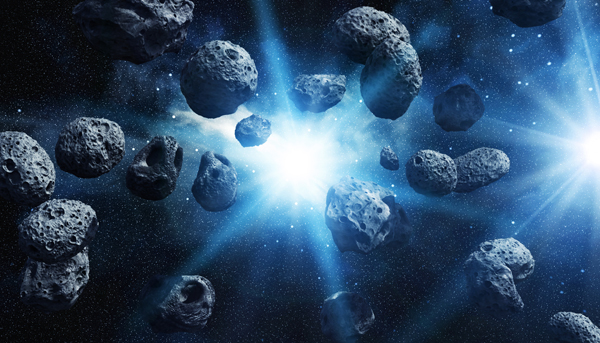
Those chunks would have been “natural” black holes. Because they necessarily retained the colossal density of the primal singularity as they were blasted out of it, they instantly “rounded” themselves into perfect spheres. They came into existence at that ancient beginning, and—since their singular known property is feeding on everything around them and continually growing—they’ve been doing so ever since and they’re all still around today. Since the singularity was the most exceedingly dense object in universal history, that extraordinary density would have been proportionally carried over into these variously-sized ejected chunks where it remains yet today. But their singular feature is turned around, and that raises a question. How these black holes’ density could have so instantly reversed from explosive (the bursting singularity) to implosive (immense gravitational attraction) is a very interesting question, and it is significant. Logically, it could have had something to do with crossing the “divide” between “the other side” (wherever it came from) to “this side” (our universe)—i.e., that divide spoken of as a “veil” in so many NDE reports.
In any case, those (assumed) blown-out chunks of singularity were what we today call “primordial” black holes, and they most probably were of two sizes—very large and very small, with little in between. The small ones would have been like the “crumbles” that fall out when you break away a large piece of cake.
Logic suggests these first very large black holes—supermassives they’re called—would have served as scaffolds for the formation of early galaxies, giving them the classic “fried-egg” profile our telescopes see at the center of most large galaxies today. The supermassives’ hugeness testifies that they could not have been birthed by the death implosion of stars, because the universe’s age, 13.8 billion years, doesn’t allow nearly enough time for their growth to such enormity. Rather, it is logical to assume they indeed arrived as un-disintegrated chunks of the big bang singularity, subsequently serving as gravitational attractors around which most of the universe’s galaxies formed. This would settle an old (and still) unsettled question of which formed first, stars or galaxies? With these huge primordial black holes pulling in and surrounding themselves with all the newborn big bang plasma in their respective neighborhoods, clearly galaxies had to come first—then and only then did stars gravitationally form, inside the galaxies, as the primordial plasma turned into atoms which accumulated as gases. All this presents new prospects for better understanding the evolution of galaxies, a full picture of which remains unsettled.
Cosmological theory says the very small ones could have been as tiny as individual atoms, though that extreme seems inherently questionable. Hawking’s theory that black holes may evaporate radiation until they disappear, questionable to begin with, seems equally inapplicable here. Given the evidence at hand, it seems more probable that the very small black holes carried into each gassy proto-galaxy are ideal candidates to have served (and may still be serving) as the attractive nuclei around which surrounding gases condensed into compacting gas balls that eventually ignited and became stars.
Finally rounding out the picture, both large and small black holes are distinct from a third, mid-range size known as “stellar” black holes, which we know were (and still are being) created much later from dying star implosions. Thus, what began as a very small primordial black hole goes through a “star cycle” in which it grows inside a star and some billions of years later emerges as a mid-size black hole.
Whether these might one day converge into the supermassive black holes at the centers of shrinking galaxies is a reasonable question. That the universe is expanding would seem to mitigate against it, however it is not clear that galaxies are expanding along with their universal surround. Scientific opinions are mixed. Though many galaxies are known to grow through collision with other galaxies (e.g., the Milky Way’s satellites), some evidence suggests many other galaxies are indeed gradually condensing. Their intrinsic gravity may be shrinking them down to a destiny in which each galaxy and its surrounds could eventually be totally pulled into a central black hole. As an idea, “As it began, so it ends” will appeal to more than a few scientific believers in the “oscillating universe” theory, where big bangs and big crunches cycle each other forever. But in more realistic scenarios, assuming ever-growing supermassive black holes could ever “empty out” intergalactic space, it is not clear whether surviving galaxies would retain sufficient gravitational density to pull themselves all back into one big final singularity—again. This question will receive a tad more attention shortly below.
[more in 2 weeks]
